Beyond the Barricade: Turning Construction Into a Placemaking Opportunity
What Miami Beach can teach developers about branding, public perception, and the value of temporary frontage.
Construction may be temporary. The impression it leaves on a community is not.
For years, construction barricades have been treated primarily as functional necessities: secure the site, screen the activity, and communicate that something is coming.
But in high-profile mixed-use, hospitality, and urban development districts, those barriers represent something much more valuable: hundreds, sometimes thousands, of linear feet of highly visible real estate.
Miami Beach offers a compelling example of how developers can turn these temporary structures into meaningful placemaking assets, using art, architecture, and storytelling to introduce a project’s identity long before its doors open.
At Kayyem Marketing & Advisory, we believe the development experience begins well before groundbreaking and continues throughout construction. Every public-facing element influences how a project is perceived, understood, and ultimately embraced.
The Opportunity Hiding in Plain Sight
Consider the amount of time a major development spends under construction.
For two, three, or even five years, its perimeter may occupy a prominent position along streets, sidewalks, retail corridors, and civic destinations.
Thousands of residents, visitors, prospective tenants, and future customers pass that frontage every week.
What do they see?
A blank fence communicates disruption.
A thoughtfully designed construction perimeter can communicate investment, progress, and a vision for what comes next.
The distinction matters, particularly in established communities where development activity can generate uncertainty about traffic, access, neighborhood character, and the future of familiar places.
A well-executed barricade program can help a community understand what it is gaining while construction is underway.
Miami Beach: Where Construction Meets Destination Branding
Miami Beach is particularly interesting because its built environment depends heavily on visual character, pedestrian activity, hospitality, and public space.
The city allows artistic murals and ornamental graphics on construction fencing, subject to applicable design review and sign regulations.
That framework creates opportunities for developers to integrate visual storytelling into the construction environment while maintaining consistency with the city’s design expectations.
Recent discussions about the city’s fencing regulations also demonstrate an important consideration: municipalities are evaluating how temporary construction environments can better communicate future development.
For project teams, the opportunity is to coordinate creative strategy, code requirements, and public-realm design early enough that the construction perimeter becomes an intentional component of the development plan.
Grand Hyatt Miami Beach: Selling the Experience Before Opening Day
The Grand Hyatt Miami Beach Convention Center Hotel offers a particularly relevant example.
The 800-room hotel, developed by Terra and Turnberry, will connect directly to the Miami Beach Convention Center, strengthening the area’s position as a major convention and hospitality destination.
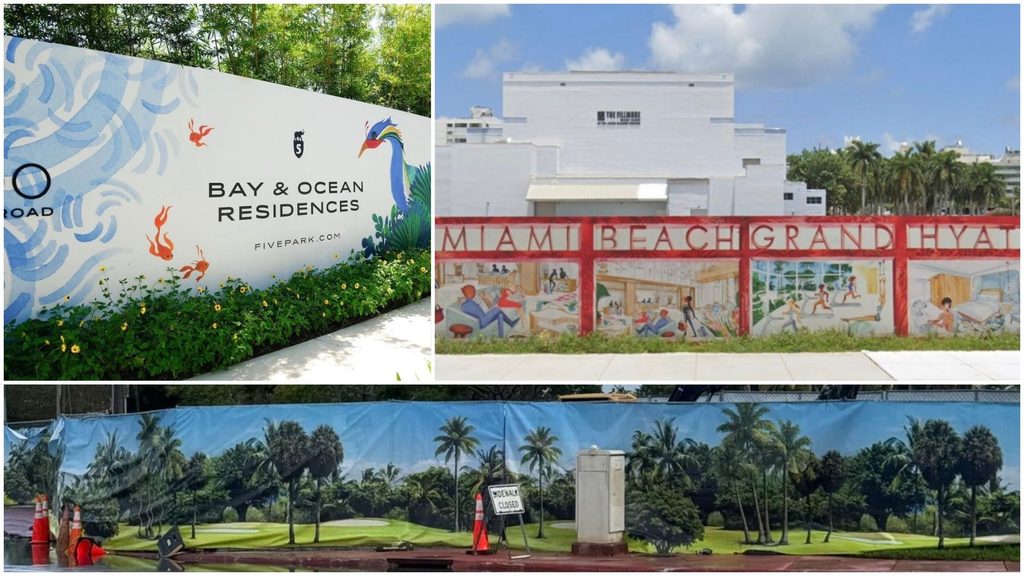
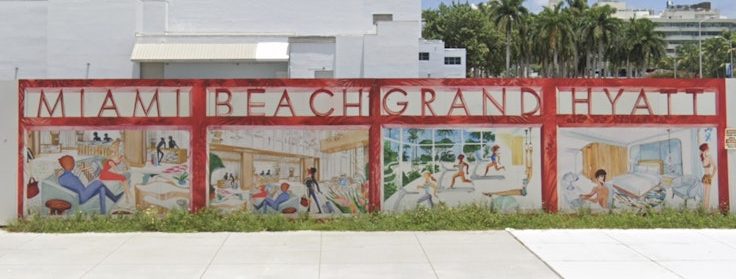
Its construction perimeter features illustrated graphics that introduce the Grand Hyatt experience through recognizable hospitality imagery.
Rather than relying exclusively on architectural renderings, the mural communicates something more immediate: the people, activities, and experiences that will eventually animate the property.
This is an important distinction in development marketing.
Architectural renderings communicate what a project will look like.
Experiential storytelling helps people understand what a place will feel like.
For a major convention headquarters hotel, that story extends beyond guest rooms. It includes the broader district, pedestrian connections, restaurants, meeting activity, and the economic benefits associated with attracting visitors.
The construction graphics provide an early opportunity to introduce that destination experience.
Image: Grand Hyatt Miami Beach construction mural.
Five Park: Building a Sense of Place Before the Building
Five Park Miami Beach provides another compelling example of development branding extending into the physical environment.
Developed by Terra, the project combines luxury residential development with public space, landscape, art, and neighborhood connectivity.
Its branded sales-gallery exterior incorporates colorful illustrations, tropical imagery, and a distinctive visual identity that reflects the surrounding Miami Beach environment.
The result is a recognizable expression of place that extends beyond the building’s architecture.
This approach is particularly relevant for mixed-use developments, where success depends on establishing a compelling relationship between individual buildings and the surrounding neighborhood.
The most effective visual programs connect the development to a broader lifestyle, community identity, and sense of belonging.
Five Park demonstrates how that narrative can begin at street level, well before a prospective resident or visitor enters the property.
Image: Five Park exterior graphics and branded environment.
Five Ways Developers Can Maximize Construction Frontage
At Kayyem Marketing & Advisory, we see five opportunities to turn construction perimeters into more valuable development assets.
1. Introduce the destination, not just the development.
Show the future public spaces, gathering places, landscaping, retail experiences, and neighborhood connections. Give people a reason to care about what is coming.
2. Build community confidence.
Use the construction period to communicate progress, explain the project’s benefits, and reinforce the investment being made in the surrounding area. This is especially important for redevelopment projects that involve changes to familiar community assets.
3. Make every linear foot work harder.
Treat prominent fence lines as temporary frontage with a defined visual hierarchy. Combine compelling imagery, public art, and selective messaging to create a cohesive experience rather than a collection of disconnected advertisements.
4. Integrate design and regulatory strategy early.
Construction graphics should be coordinated with development approvals, signage regulations, architectural design, and public-realm planning. Early collaboration can unlock creative opportunities and avoid expensive redesigns.
5. Create content that extends beyond the site.
Well-designed graphics provide natural opportunities for photography, social media, construction updates, leasing presentations, data collection, project messaging and community engagement. The investment can support multiple communications channels throughout the development lifecycle.
The Bigger Opportunity: Marketing During the Development Process
Development marketing is often concentrated around major milestones: project announcements, leasing launches, groundbreaking ceremonies, and grand openings.
Yet the months and years between those moments represent an equally important period for shaping public perception.
Construction graphics are one component of a larger development communications strategy that can include community updates, pedestrian wayfinding, public art, stakeholder engagement, and programming.
When coordinated effectively, these efforts create continuity between the development vision and the experience people have while that vision is becoming reality.
For owners and developers, this requires looking beyond the immediate cost of producing a barricade wrap and considering the strategic value of the frontage itself.
The question becomes:
If your development will occupy an important piece of the public realm for the next three years, what is that space communicating every day?
At Kayyem Marketing & Advisory, we work with owners, developers, and institutional partners to align development strategy, stakeholder engagement, branding, and communications throughout the project lifecycle.
Because the experience of a place begins long before opening day.
And every linear foot is an opportunity to tell its story.